
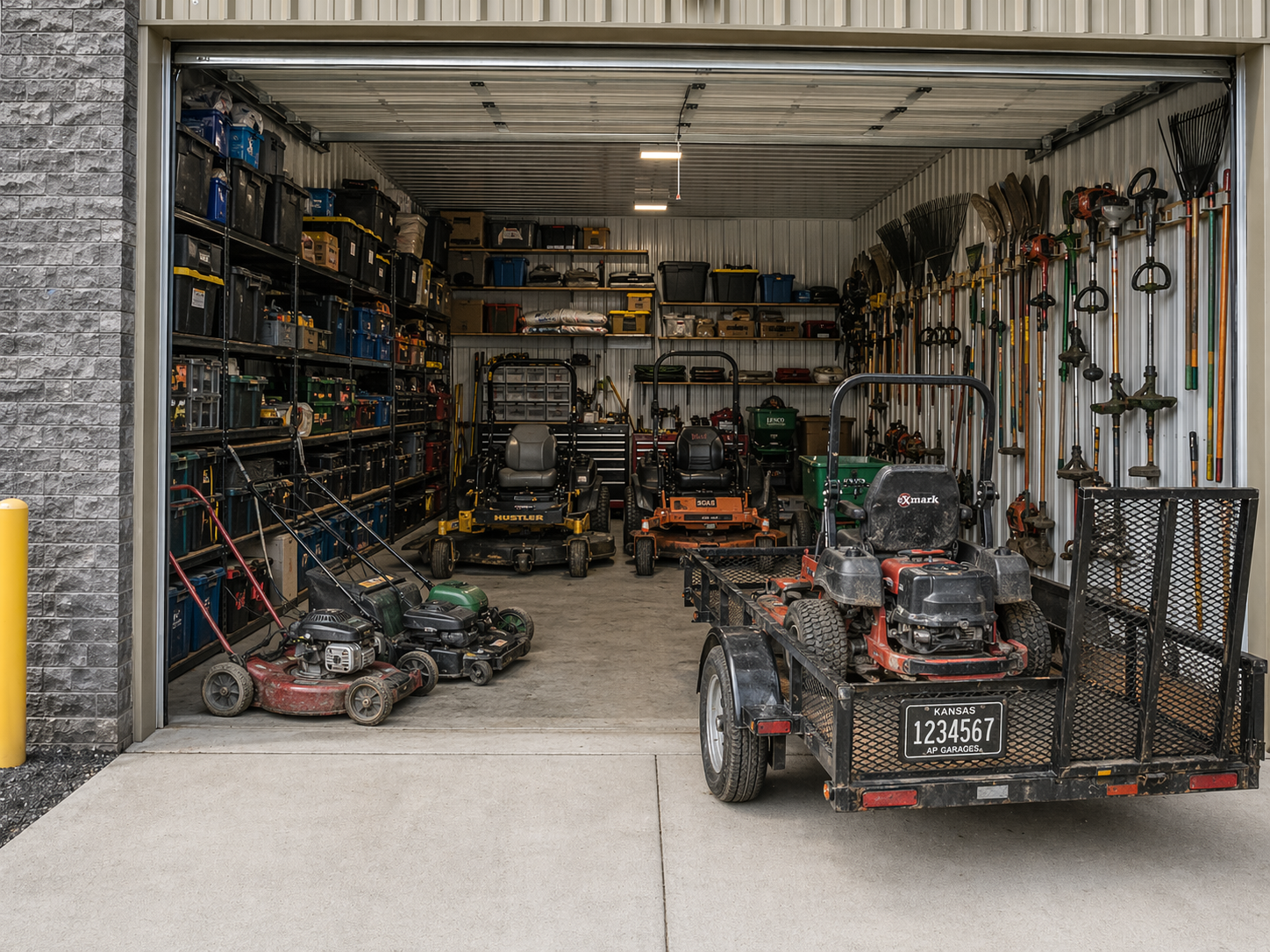
Are you a lawn care professional faced with the challenge of supporting a busy spring schedule from a storage space that was never designed to hold everything in active rotation at once? As mulch season, mowing, and turf maintenance kicks in, your mowers, spreaders, trailers, and overflow gear can all feel like they are competing for the same square footage.
A more organized setup in the place where your gear is accessed can make daily work easier to manage. Just a few changes to how your equipment is stored, staged, and maintained can make your whole operation run easier.
A useful spring reset often starts with a simple question: which services are taking up the most space right now?
If mulch and bed work are showing up every week, those tools should move forward. If spreaders and treatment supplies need to stay ready, they should have a consistent place. If mowing equipment has become part of the daily routine, it should not be boxed in by items used only occasionally.
When the tools for current jobs are grouped together and easy to reach, loading gets faster, cleanup gets easier, and the workday starts with less reshuffling.
As mulch jobs and material pickups become more common, trailers often move from occasional use to repeated daily use. That makes late spring a good time for a full checkup before heavier hauling becomes part of the weekly rhythm.
Lights, wiring, brakes, tires, ramps, straps, and tie-down points all deserve attention. So does the inside of the trailer itself. Leftover clutter from earlier jobs can become a problem once repeated loading and unloading starts becoming more common.
Trailer prep is also much easier when there is enough room to park, walk around, inspect, and stage equipment without working around a crowded residential garage or tight driveway. AP Garages offers oversized enclosed units with 24-hour access and automatic garage doors, which can give lawn care businesses more room to organize trailers and larger equipment during busy spring work.
Some spring services come with tighter timing than others. When that happens, the equipment tied to those jobs needs to be ready, accessible, and grouped with the materials that go with it.
Spreaders, sprayers, gloves, markers, measuring tools, and smaller accessories are easy to misplace when seasonal items are stored inconsistently or mixed in with unrelated equipment. The same goes for materials. When products, tools, and cleanup items are stored in separate places, even a straightforward service can take longer to stage than it should.
One of the easiest fixes is to store equipment by task instead of by size or wherever there happens to be room. Keeping related items together helps narrow seasonal windows feel more manageable and keeps mornings from starting with unnecessary searching.
As mowing season settles into a weekly rhythm, daily-use equipment should be the easiest equipment to reach.
Blades, batteries, belts, trimmers, blowers, and backup handheld tools should not be sitting behind overflow items or mixed into a catch-all corner. When a high-use machine needs attention, quick access matters. A small maintenance issue becomes much easier to handle when the necessary tools and parts are already within reach.
A clear “grab first” zone helps separate the equipment used on most days from the equipment that only rotates in as needed. That kind of separation becomes harder to maintain when storage space is tight, which is one reason larger enclosed storage can make operations easier once the equipment list starts growing. AP Garages offers large units built for oversized storage needs, including business setups that extend well beyond what a typical garage can comfortably hold.
Spring often brings smaller in-between jobs that interrupt a tightly planned day more than expected. A quick repair visit, a touch-up request, or a smaller add-on service can take longer to support when the materials for it are scattered across shelves, toolboxes, and trailers.
A small-job station can help keep those tasks from becoming a larger disruption. Hand tools, extra materials, cleanup supplies, and smaller accessories can all be grouped in one place so they are easy to load without interrupting the rest of the setup.
This kind of station is especially helpful during weeks when regular route work is already full and there is still a need to fit in one more stop without creating a separate loading project for it.
Mulch and bed work bring a different kind of clutter than mowing or lawn treatment services. Rakes, shovels, wheelbarrows, tarps, edging tools, and cleanup gear can spread quickly if there is no designated area for them.
Giving those tools their own zone helps keep them from taking over the entire storage area. It also makes cleanup easier after long days when dirty tools, empty bins, and leftover material supplies need a place to go without blocking the next morning’s equipment.
That separation becomes more valuable during the busiest weeks, when one pile of mixed spring tools can slow down several different types of work.
One of the biggest slowdowns this time of year often comes from the equipment that is needed often, but not every day.
Backup mowers, extra trimmers, spare tires, specialty hand tools, repair items, and rotating seasonal gear all fall into that middle category. They should not be hard to access, but they also should not crowd the equipment used every morning.
When there is no dedicated space for those items, they tend to end up in walkways, behind primary machines, or piled into corners that crews need to access constantly. That is where larger enclosed storage starts becoming practical instead of optional.
AP Garages rents oversized enclosed units, including 45' x 15' x 14' and 45' x 20' x 14' spaces, with features such as insulated buildings, security cameras, and automatic garage doors that support larger equipment storage and easier access during busy seasons.
A simple weekly reset can keep spring organization from slipping as the schedule gets busier.
That reset may include returning tools to the same location, restocking the supplies that run low most often, clearing broken equipment out of the ready-to-use area, and checking that trailers are still prepared for the kind of hauling expected in the coming days.
The routine does not have to be complicated. It just needs to happen consistently enough that each week does not start with a full reorganization.
Spring is easier to manage when the storage space behind the work is set up to support it. When trailers are ready, high-use equipment is easy to reach, and overflow gear has its own place, your entire operation can move more smoothly.