
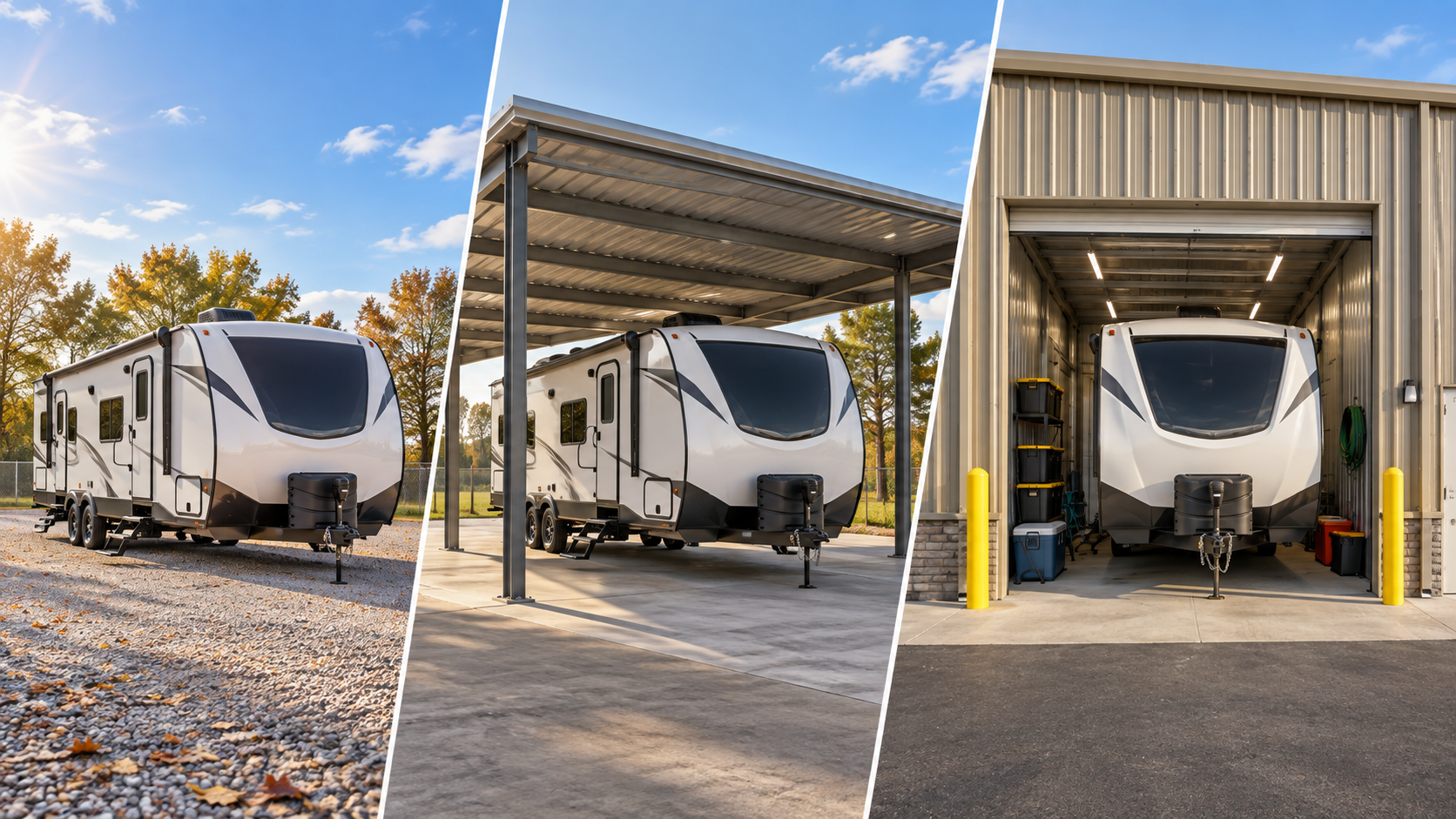
Open, covered, and enclosed vehicle storage each offer a different balance of cost, protection, privacy, convenience, and usable space. The best fit depends on what you’re storing, how often you use it, how much weather exposure you’re comfortable with, and whether you need room for gear and equipment in addition to the vehicle itself.
For some owners, a simple parking space is enough. Others may find that the added protection of covered or enclosed storage better matches the value of the vehicle and the way they use it. This article looks at the practical pros and cons of each option so you can compare them on the factors that matter most.
Parked. Covered. Garaged. There’s a difference.
Open vehicle storage is often the most straightforward and least expensive option. It provides an RV, boat, trailer, or other vehicle a designated parking space outside the home. Depending on the facility, that space may also be inside a gated or monitored property, which can make it a practical solution for owners whose main priority is getting a large vehicle out of the driveway or complying with neighborhood restrictions.
For durable trailers or vehicles that are used frequently, open parking may be entirely sufficient. The tradeoff is that the vehicle remains exposed to the same kinds of conditions it would experience in a driveway or side yard, including:
That exposure does not make open storage a poor choice; it simply means weather protection is not part of what you are paying for.
Covered storage adds a roof over the vehicle while generally leaving the sides open, creating a useful middle ground between basic parking and full enclosure. For RVs, boats, and trailers that would otherwise spend long periods in direct sun or precipitation, overhead protection can reduce UV exposure, keep heavy rain and snow off upper surfaces, and slow some of the weathering that comes with year-round outdoor storage.
The remaining tradeoff is side exposure. Depending on the design and orientation of the structure, a covered vehicle may still be exposed to:
For an owner who mainly wants to protect a roof, paint, seals, or interior from direct sun and precipitation, those tradeoffs may be perfectly reasonable. Covered storage offers a meaningful increase in protection without the higher cost or larger footprint associated with an enclosed garage.
Enclosed storage changes the environment around the vehicle by moving it from an outdoor stall into its own bay. That reduces exposure not only to direct sun and precipitation, but also to wind, blowing debris, and public visibility, which can matter more for vehicles that sit unused for longer periods or represent a significant investment.
The other advantage is usable space. Depending on the size of the bay, an enclosed unit can accommodate not only the vehicle itself but also the equipment, supplies, and recreational gear that belong with it. That makes enclosed storage less like renting a parking space and more like adding another garage.
Weather protection is often reduced to a simple question of whether the vehicle is under cover, but long-term exposure is more complicated than that. UV light can affect paint, plastics, trim, seals, roofs, and interior materials, while moisture can collect in small gaps or around exterior components. Freeze-and-thaw cycles can add stress over time, and wind carries dirt, pollen, leaves, and other debris around and underneath the vehicle.
Those effects are cumulative. A vehicle used every weekend may spend relatively little time sitting in one place, while an RV or boat parked from late fall through spring can spend months exposed to whatever conditions surround it. That does not mean every vehicle needs maximum protection, but the amount of time a vehicle sits, its value, and the owner’s tolerance for weathering should all be part of the comparison.
For many recreational owners, parking the vehicle is only one part of the storage problem. An RV may come with leveling blocks, hoses, chairs, grills, tools, camping equipment, and outdoor furniture. A boat may bring life jackets, fishing rods, towables, dock equipment, coolers, batteries, and cleaning supplies. ATVs and motorcycles often come with helmets, ramps, riding gear, spare parts, and maintenance tools.
Open and covered storage primarily solve the question of where the vehicle goes, while enclosed storage can also help answer the question of where everything associated with it goes. Keeping gear with the vehicle can free up significant space at home and simplify trip preparation because the entire setup stays together instead of being scattered through a garage, basement, or shed.
That becomes especially useful for people who use their recreational vehicles throughout fall or spring and want to take advantage of a good-weather weekend without rebuilding the entire loadout each time.
A highly protected storage space is less useful if retrieving the vehicle is inconvenient, so access should be part of the decision from the beginning. For owners who use an RV, boat, ATV, or seasonal vehicle throughout the year, the practical questions are about how easily the space fits into the way they actually travel and recreate.
Useful questions to consider include:
When those answers are favorable, storage stops feeling like a dead end and starts working more like a staging point between trips.
A gated lot can provide useful access control whether vehicles are parked in the open, under a canopy, or inside enclosed units, but enclosure adds another factor: privacy. A vehicle parked outdoors remains visible to people moving through the property, while an enclosed unit places both the vehicle and related gear out of sight when the door is closed.
That does not mean every enclosed facility offers the same level of security, and owners should still compare access controls, facility policies, and other security features. For someone who stores tools, recreational equipment, or other items with a vehicle, however, a private enclosed bay offers a different storage environment than an open stall.
There is no single best choice for every vehicle. The right option depends on how much protection you want, how you use the vehicle, what else needs to be stored with it, and how much you want to spend.
Open parking may make sense if:
Covered storage may be a good fit if:
Enclosed storage may be worth considering if:
All Purpose Garages is designed for owners who want storage to do more than get a large vehicle out of the driveway. Our oversized enclosed bays provide space for RVs, boats, trailers, collector cars, ATVs, and other large recreational equipment, while single RV-width garage doors and drive-up access make it practical to move vehicles in and out.
The enclosed space around the vehicle can also be used for the gear, tools, and supplies that belong with the activity. The boat can stay with the life jackets, fishing gear, and coolers; the RV can stay with the chairs, hoses, and camping equipment; and the ATV can stay with the helmets, ramps, and riding gear. Instead of moving the vehicle somewhere else while everything associated with it continues taking over the garage at home, the whole setup can have its own place.
With 24/7 gated access, optional electrical service in select units, and convenient access to major roads from the Overland Park area, the space can remain useful between trips as well as between seasons. A parking space gives your vehicle somewhere to sit, a roof adds another level of protection, and an enclosed garage gives you protected, private, usable space for the vehicle and everything that goes with it.
Don’t just park it. Garage it.