
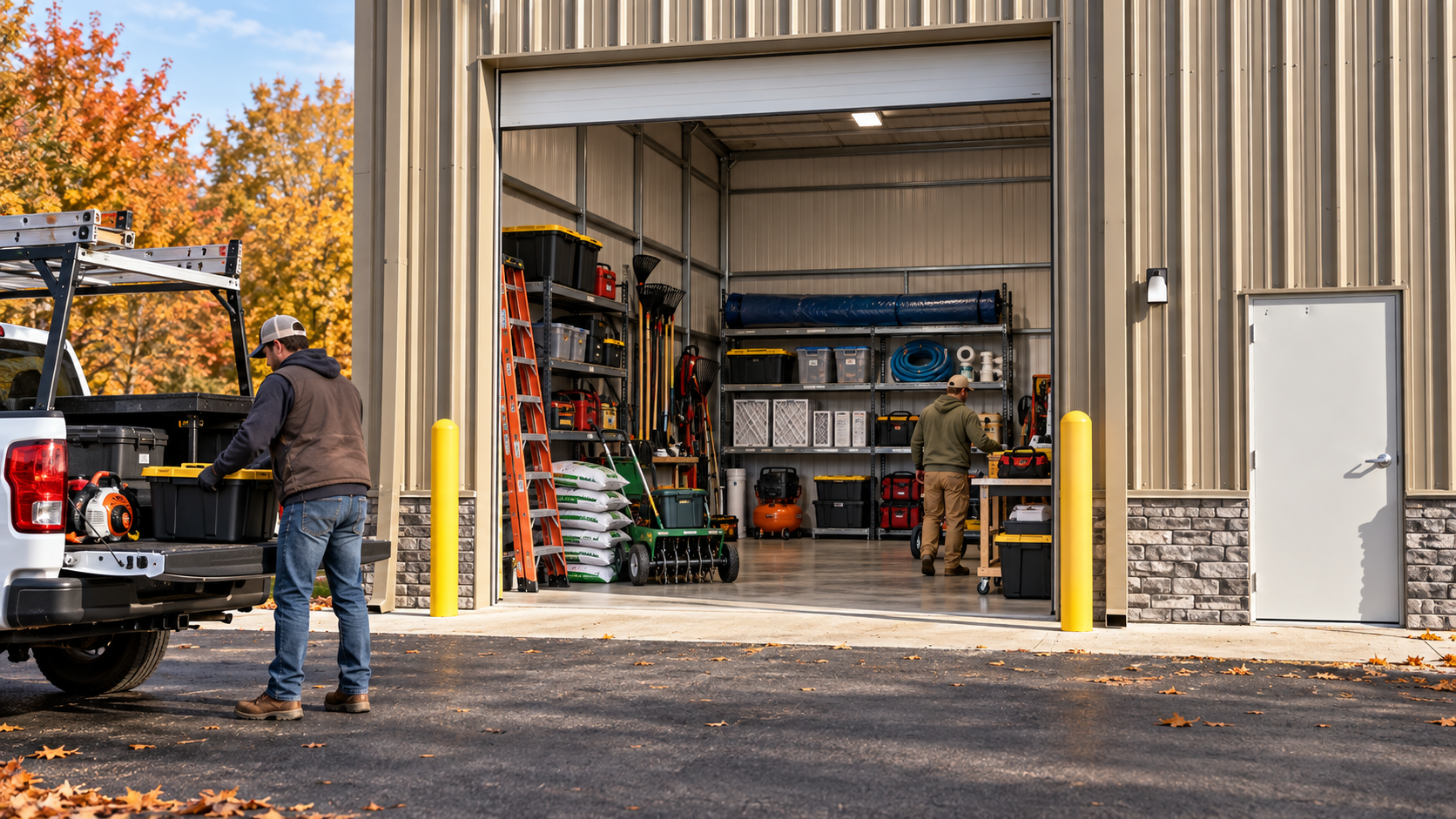
Pool service companies may experience one of the clearest fall equipment transitions. During the warmer months, trucks are typically set up for routine cleaning, testing and water maintenance. As closing season arrives, the work shifts toward preparing pools and equipment for periods of low use and, in colder climates, protecting systems from freezing conditions.
Common fall work may include:
The equipment mix changes along with the work. Compressors or high-powered vacuums, hoses, fittings, winter plugs and cover equipment may suddenly become part of the daily loadout, while some routine summer tools are needed less often. A dedicated storage space allows a company to make that transition intentionally rather than piling closing equipment on top of everything already carried through summer.
For a crew handling several closings in a day, the benefit is practical: seasonal equipment can be grouped together, trucks can be stocked for the jobs actually on the schedule, and warm-weather equipment can remain protected and nearby until it is needed again.
Fall landscape work tends to overlap with the end of summer rather than replace it all at once. Mowing may continue for weeks while aeration, overseeding, fertilization and leaf management are added to the schedule. For cool-season turf in particular, the National Association of Landscape Professionals identifies fall as an important period for aeration and seeding because cooler conditions support recovery and root development.
Common fall work may include:
That overlap can make fall one of the most equipment-heavy parts of the year. Mowers and trimmers may still be working while aerators, seeders, blowers, tarps and collection equipment all need room as well.
Storage gives landscape businesses a way to stage equipment according to the work that is most active. Machines that are being used less frequently can move out of prime trailer space without disappearing into some far-off warehouse, while fall and eventually winter equipment can become easier to access.
For irrigation contractors, fall brings a concentrated period of shutdown and winterization work in climates where systems are vulnerable to freezing. The job mix becomes more repetitive and specialized, which makes organization especially useful: crews may be loading the same compressors, hoses, fittings and adapters day after day.
Common fall work may include:
This kind of seasonal work is a good example of why contractor storage is about more than simply finding a place to put things. When a business knows which equipment it will use repeatedly for the next several weeks, that equipment can be staged where crews can load it quickly while less urgent installation supplies move farther back.
For smaller irrigation companies, the result can feel a little like having a shop without taking on the expense or commitment of a full commercial warehouse.
HVAC contractors usually see more of an inventory transition than a dramatic equipment swap. As air-conditioning demand starts to ease, fall maintenance and heating-season preparation become more important. Fall is a strong time for maintenance work ahead of winter.
Common fall work may include:
For these businesses, fall storage can function as an inventory hub. Bulk filters, replacement parts, consumables and less frequently used equipment do not all need to live in the service van, particularly if technicians can restock from an organized central location.
The benefit is not just more room. It can also make inventory easier to see and manage, which is useful when the alternative is spreading parts across several vans, a home garage and whatever shelves happen to be available.
Exterior service companies often face an overlapping season too. Pressure washing and surface cleaning may continue while falling leaves create more demand for gutter cleaning, downspout clearing and exterior debris removal.
Common fall work may include:
That can quickly broaden the equipment mix. Pressure washers, hoses and surface cleaners may still be in regular use just as ladders, blowers, extension poles and debris-handling equipment become more important.
Storage gives these companies more flexibility to load vehicles for the work actually scheduled that day. Less frequently used equipment remains nearby and protected without requiring every truck or trailer to carry the entire business at once.
Pest-control companies also see the work change as temperatures fall. The National Pest Management Association notes that rodents and other pests are more likely to seek food and shelter indoors as cooler weather arrives. In fall 2026, NPMA is also warning that warmer-than-average conditions may keep some summer pest activity going longer before colder weather pushes other pests indoors, creating an especially mixed seasonal workload. (PestWorld)
Common fall work may include:
For technicians, that can mean carrying more exclusion and monitoring materials alongside the regular products already used for routine service. A separate storage space makes it easier to keep bulk supplies organized and restock as the mix of calls changes, rather than making every vehicle responsible for every possible job.
Across all of these industries, the underlying storage problem is similar. A growing contractor may own equipment for many different kinds of work, but only part of that equipment needs to travel to today's job.
Your truck should carry today's work — not your entire business.
Seasonal equipment rotation can help contractors keep frequently used tools accessible while protecting equipment that will be needed again later. It can also move bulk supplies and larger equipment out of home garages and reduce the amount of unnecessary gear competing for room in trucks and trailers.
For many small businesses, that can mean:
For many small contractors, there is an awkward stage of growth between working entirely from home and needing a traditional commercial warehouse. Equipment accumulates faster than usable space, the home garage gradually disappears, and trucks and trailers begin carrying items simply because there is nowhere else convenient to put them.
All Purpose Garages can provide another option. Oversized enclosed spaces give equipment-heavy businesses room to organize tools, machinery, materials and seasonal inventory in one dedicated location while keeping them accessible as the work changes. Instead of trying to find room for every season at once, contractors can create a more useful rotation: keep today's equipment easy to reach, organize the next season's supplies nearby, and move the rest out of the way until it is needed again.
For businesses with too much equipment for the home garage but no need for a full warehouse, that extra space can become a practical extension of the operation rather than simply another place to put things.